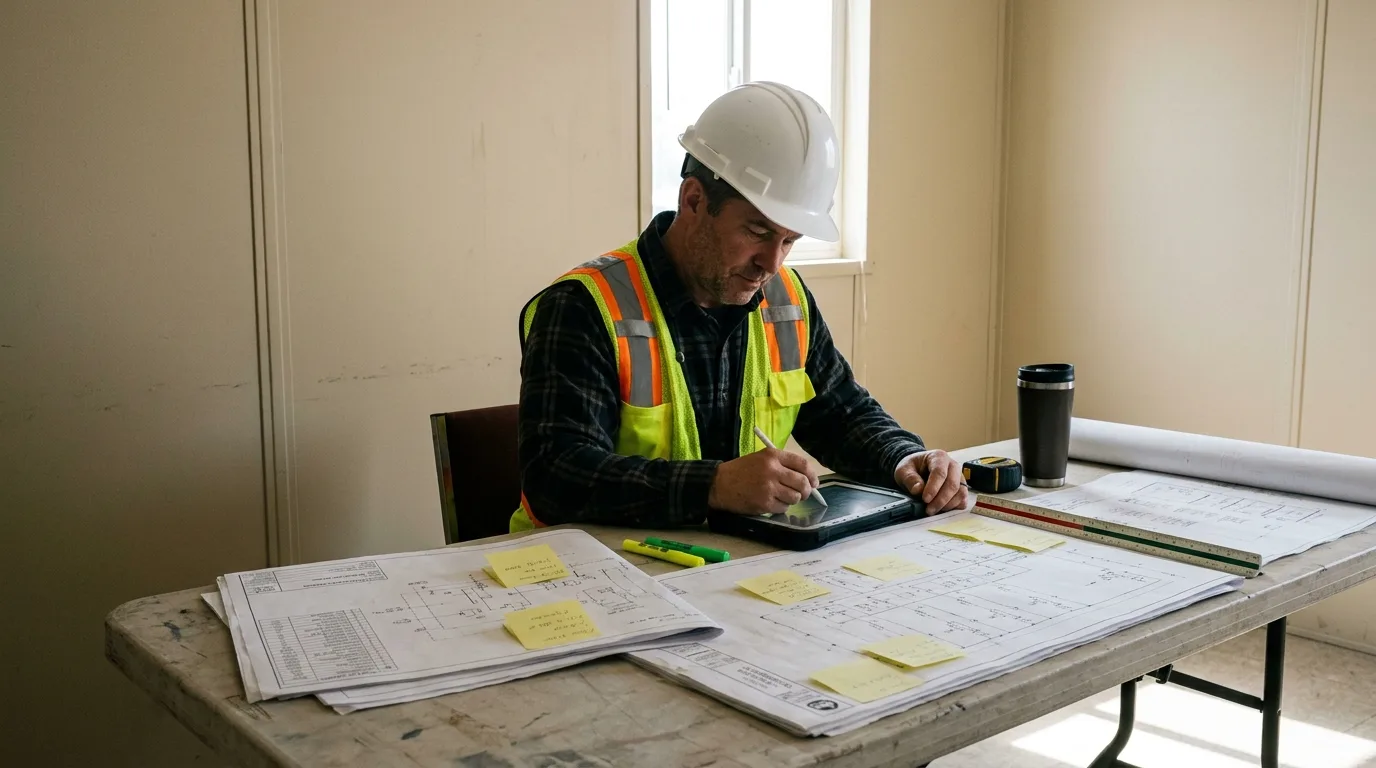
An RFI, or request for information, is a written question sent to the design team when the drawings or specifications do not give you what you need to build or price the work. This page gives you a Word form, an Excel log to track every RFI, and a PDF of the form. After the template you will find 16 electrical examples with ready wording.
The template
The Word form has these fields:
- RFI no., project, date, to and from.
- Sheets / details and grid / location: where the problem is.
- Question: one question only.
- Priced as: your assumption, which stands until the question is answered.
- Suggested solution: your proposed answer.
- Response needed by.
- Cost impact and schedule impact: yes or no, with an amount or days.
- Response area: for the design team to answer, sign and date.
The Excel log has one row per RFI: number, date sent, to, sheet, subject, priced-as, due date, status, date answered, days open (a formula), cost and schedule impact, and a response summary. At the top, formulas count open, answered and closed items and flag overdue ones. The PDF is the same form for printing.
Pre-bid RFI or construction RFI
The two look alike, but the rules differ.
Pre-bid RFIs go out during bidding. The answer, if it comes, usually arrives as an addendum that every bidder receives. Deadlines are short and often fixed by the bid documents. Ask only what changes your price. If no addendum follows, price your assumption and write it as a clarification in your bid.
Construction RFIs go out after award. The answer is part of the project record. If the answer adds work beyond what you priced, the RFI is your starting point for a change order: it shows what the drawings said, when you asked, and how you priced it. For the electrical contractor, this is the main reason to write RFIs rather than phone calls. Follow the process in your contract, because it may say who sends RFIs, to whom, and how fast the design team must answer.
Sixteen electrical RFI examples
These are written in our own words. Most follow question types that came up in our tests of counting devices from real drawing sets; a few, such as plan against spec, are common RFIs on any job. Sheet numbers and details are placeholders. Replace them with yours, and keep the "priced as" line honest.
- Fault current above breaker rating. The one-line shows available fault current higher than the AIC rating of the breakers. Ask: "Sheet E3.01 shows [value] available fault current, but panel [name] breakers are rated [value]. Please confirm required AIC ratings. Priced as: breakers rated per the panel schedule."
- Symbol not in the legend. "The symbol at grid [C/4] on E1.01 is not shown in the legend. Please identify it. Priced as: [device]."
- Required by notes but not drawn. "Keyed note 1 requires time clocks, but none are shown. Please give the quantity and locations. Priced as: one time clock per [area]."
- Fan disconnects. "General note G requires a disconnecting means at each motor. None are drawn at the six exhaust fans. Priced as: no separate disconnects, cord-and-plug or built-in only."
- Missing panel schedule. "Emergency panel [name] is fed on the one-line and has circuits listed on E1.21 but no schedule in the set. Please provide it. Priced as: [size] breakers, feeder per one-line."
- A circuit to a room that does not exist. "Panel [name] circuit 39 feeds 'counter receptacle, Room 211.' No Room 211 is on the plans. The nearest counter is in Room 210. Priced as: Room 210."
- Devices with no circuit. "Six junction boxes on E1.01 show no circuit number or function. Please give use and circuit. Priced as: box and connection only, with no device."
- New or relocated. "Fire alarm devices on E1.11 are not marked new or relocated, and the demolition notes allow salvage. How many are reusable? Priced as: all devices new."
- Who furnishes fire alarm. "Is the fire alarm panel and its devices by a separate fire alarm contractor? Priced as: raceway and boxes only, by us. Devices by others."
- Furniture feeds. "Receptacles and boxes tagged 'F' appear at the cubicles. Does the furniture vendor supply the devices, with us supplying only the feed? Priced as: feed and box only."
- Wiring method not stated. "No wiring method is given for the branch circuits on E1.01 or in the spec. Please confirm conduit type. Priced as: EMT in exposed areas, MC cable in stud walls."
- GFCI near sinks drawn inconsistently. "General note B requires GFCI within six feet of a sink. Two custodial receptacles and one refrigerator receptacle are within that distance but are drawn as standard duplex. Priced as: GFCI at those three."
- Plan against spec. "Sheet E1.01 shows 20 A, 120 V receptacles at the stage; Section 26 27 26 calls for 20 A tamper-resistant GFCI. Which governs? Priced as: spec."
- Reference to a sheet that does not exist. "Keyed note 5 refers to sheet E2.0. The set has E2.01. Please confirm that the grounding detail on E2.01 is meant. Priced as: E2.01."
- Quantity the drawings leave open. "Occupancy sensors are drawn as one symbol per room with a note that the contractor determines quantity. Please give the intended coverage. Priced as: [number] sensors and [number] power packs."
- Group marks on switches. "Switch symbols marked 'S3 (a,b,c)' appear on E1.21. We read each as three switches for zones a, b and c. Please confirm. Priced as: three switches each."
How to write an RFI that gets answered
- One question per RFI. A long list gets a partial answer, and the rest sits open.
- Point to the place. Give the sheet, detail, room and grid. Attach a cropped screenshot with the spot marked.
- Show your reading. State what you found, then what is missing. Do not write "unclear".
- Offer a solution. A yes-or-no question is faster to answer than an open one.
- Write the "priced as" line. It tells the team what happens if they say nothing, and it is your record.
- Set a date. Make it reasonable. Give at least a few working days unless the bid deadline forces less.
- Be neutral. The RFI is not a complaint. Keep it short and polite.
- Log it. Use the Excel log and follow up before the due date, not after.
Find the questions earlier
Finding these questions usually takes a slow read through the whole set. Our electrical takeoff software lists the open questions it finds while counting. See real results on the sample takeoffs page. For symbols and legends, read electrical blueprint symbols and how to read electrical blueprints. Tie your answers back to the estimate template and the panel schedule template.
FAQ
Usually the engineer of record or architect, through the general contractor. Send it to whoever your contract names, normally the general contractor.
Yes, for items that change your price and that you cannot reasonably assume. Check the bid documents for the deadline for questions.
Keep the "priced as" line in your bid or contract file, follow up in writing, and note the date. If the final answer changes your cost, use the RFI record to support your change order request.
References
Sources
- Wikipedia, "Request for information": general definition of an RFI, including its construction use.
Contract rules for RFIs vary. Your contract documents, or a licensed attorney, decide your deadlines and your right to a change order.